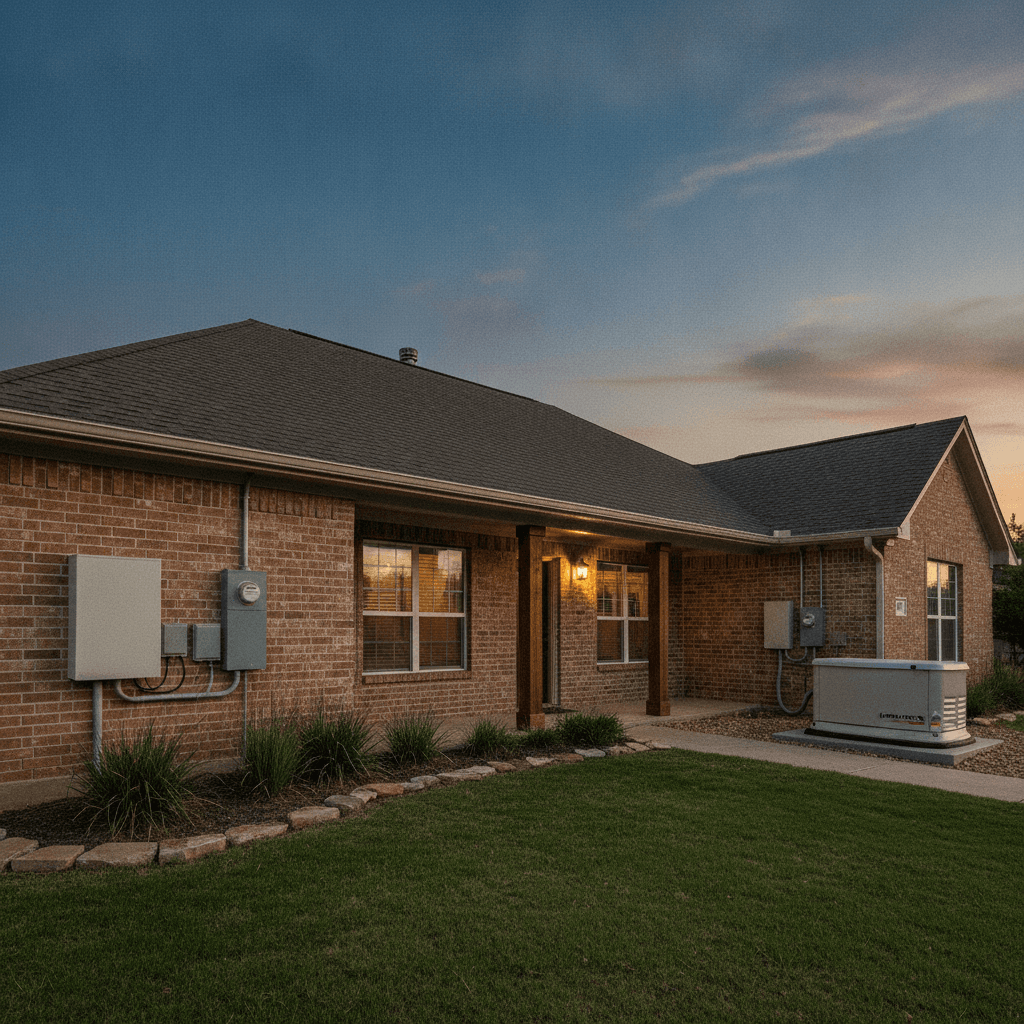
Home battery vs standby generator in Texas compared with real numbers: runtime, central AC starting power, noise, fuel burn, maintenance cost, and 10-year ownership.
Backup Fit
Quick answer: A single home battery is quiet and automatic, but on stored energy alone it cannot cover a multi-day Texas outage: a Tesla Powerwall 3 (13.5 kWh usable) runs about 6.8 hours at a 2 kW essential-loads pace with no recharge. A 22kW standby generator on natural gas can run as long as the utility gas line holds, or roughly 4.5 to 6.6 days on a full 500-gallon propane tank, but it burns fuel, needs $200 to $600 a year in maintenance, and runs at about 66-67 dBA at 23 feet versus the battery's under-50 dBA operating sound. Checked September 16, 2026.
Best for
Homeowners comparing battery quotes in Texas.
Wrong fit
Off-grid cabins, RV systems, marine systems, or commercial storage projects.
Tradeoff
A lower quote is not better until the backup design, usable kWh, and incentive assumptions match.
A single home battery is quiet and automatic, but on stored energy alone it cannot cover a multi-day Texas outage. A 22kW standby generator can run for days on propane or indefinitely on utility natural gas, but it burns fuel, needs annual service, and is measurably louder. Checked September 16, 2026.
The goal is not to pick the side with the better marketing. It is to see the actual numbers, decide which outage you are really planning for, and know what a fair quote for either system, or both together, should include.
Quick Answer
For short, frequent outages and quiet, automatic backup, a home battery wins outright. For multi-day outages, especially with central air conditioning that has to run, a standby generator is usually the stronger single system, and a hybrid design (battery for the daily case, generator or solar for the multi-day case) is often the actual right answer once you compare runtime, noise, fuel, and maintenance side by side.
The comparison, with numbers
Figures use a single Tesla Powerwall 3 (13.5 kWh usable, 11.5 kW continuous) as the reference battery, since it is this site's standard benchmark system, and a 22kW air-cooled Generac home standby generator as the reference generator, since it is the size most commonly quoted for a Texas whole-home design with central AC.
Dimension
Home battery (1 unit)
22kW standby generator
Why it matters
Installed cost
$11,500-$18,000
$9,500-$18,000 nationally; often $12,000-$20,000 all in for a Houston-area whole-home install with a new propane setup
About 27 hours at a 0.5 kW essential-loads pace, 6.8 hours at 2 kW, and roughly 2.7 hours if whole-home load with AC hits 5 kW
Runs as long as fuel lasts: effectively unlimited on a utility natural gas line, or about 4.5 days at full load to 6.6 days at half load on a full 500-gallon propane tank
A battery is a fixed energy bucket unless it is recharged. A generator is a fuel-conversion machine that keeps going until the tank or the gas line runs dry.
Central AC starting
A single Powerwall 3's 11.5 kW continuous rating clears a typical 3-ton AC's starting draw (about 7,200 W); a 3.5-ton unit sits closer to that ceiling, and Enphase-based systems (3.84 kW continuous per unit) generally cannot start AC alone
A 22kW unit's continuous output comfortably exceeds a 3-ton AC's running load (3.5-5 kW) and its starting surge (about 15-18 kW), but Generac itself recommends a load manager or soft-start kit so the AC surge does not stack with other large loads starting at the same moment
Stored energy is not the same as the power needed to start a compressor. Both technologies can usually start a 3-ton AC; margin gets tighter at 3.5 tons or when other big loads run at once.
Noise
Under 50 dBA typical, under 62 dBA maximum, measured at 1 meter (Tesla's own spec)
About 66-67 dBA at 23 feet for a 22kW-class unit, roughly the loudness of a running dishwasher
Even measured about seven times farther away, the generator is clearly audible outside and often inside the house; the battery is close to inaudible over normal household sound.
Fuel and refueling
None; recharges from the grid or solar
Natural gas: none, draws from the utility line. Propane: needs a sized tank (commonly 250-1,000 gallons) filled and monitored ahead of hurricane season
Natural gas removes the refueling question but ties the generator to the same utility grid infrastructure that can also be stressed in a major event. Propane is self-contained but finite.
Annual maintenance
No routine paid service is published by battery manufacturers for normal operation
Roughly $200-$600 a year for oil, filter, spark plug, and battery checks, on a factory schedule of about every 200 hours or 2 years for basic service, every 400 hours or 4 years for a larger service
An unmaintained generator is also the single most common reason a Texas standby generator fails to start during the outage it was bought for.
Warranty / design life
10-15 year manufacturer warranty terms with a 60-70 percent end-of-term capacity guarantee, brand-dependent. See the warranty guide
5-year limited manufacturer warranty is typical on a 22kW unit; a well-maintained standby generator commonly reaches 20-30 years or 10,000-30,000 engine hours before major overhaul
Different warranty structures: a battery warranty guarantees a capacity floor, a generator warranty covers parts and workmanship, not fuel-burn efficiency over time.
Rough 10-year ownership
About $11,500-$18,000 total: the installed price, since there is no fuel cost and no manufacturer-published routine service requirement
About $11,500-$24,000+ before fuel: installed cost plus roughly $2,000-$6,000 in maintenance over 10 years, plus real fuel cost that scales entirely with how many hours it actually runs during outages
The generator's total cost is far more sensitive to how often and how long the grid actually goes down in your specific area.
These are planning estimates built from manufacturer specs and independent cost trackers, not a quote. Your installer's numbers will vary with your home's electrical service, local labor rates, and, for a generator, whether a new gas line or propane tank is part of the job.
Why continuous power, not stored energy, decides the AC question
A battery or a generator can both have "enough energy" and still fail to start a compressor, because starting a motor needs a burst of power well above its steady running draw. The whole-home vs. critical-loads guide has the full circuit-by-circuit breakdown; the short version here is that a single Powerwall 3's 11.5 kW continuous rating and a 22kW generator's roughly 21+ kW continuous output both clear a 3-ton AC's published starting draw, but the margin shrinks fast at 3.5 tons or when a well pump, dryer, or second AC unit tries to start at the same time. That is what a generator's load-management accessory and a battery's smart circuit panel are both actually for.
Multi-day outages: what refuels itself and what does not
A single battery with no recharge source is a fixed bucket of energy. Running a 13.5 kWh Powerwall 3 at a steady 2 kW essential-loads pace uses it up in about 6.8 hours, according to the runtime math in how long a home battery lasts. Getting a battery through a multi-day outage means adding solar recharge or accepting that it only covers the first several hours; the battery-without-solar guide works through exactly how much daily solar recharge changes that math.
A standby generator does not have this ceiling in the same way. On a home already served by utility natural gas, the generator can run for as long as gas keeps flowing to the house, since it draws from the utility line rather than an on-site tank. On propane, runtime is set by tank size: a common 500-gallon residential tank holds a maximum of 400 usable gallons under the National Fire Protection Association's 80 percent fill rule (NFPA 58), which works out to roughly 108 hours (4.5 days) of continuous full-load runtime, or about 158 hours (6.6 days) at half load, for a 22kW unit burning propane at its published rate. Real household loads cycle well below full load most of the time, so actual runtime on a given tank is usually longer than the full-load number.
Natural gas is not a guarantee in a true worst-case event. Winter Storm Uri in February 2021 also strained upstream natural gas production and processing in Texas, which was a major contributor to the generation losses that triggered ERCOT's rolling blackouts, even though residential natural gas distribution mostly held up. It is a real, if less common, failure mode worth naming rather than assuming a gas hookup is bulletproof.
Texas outage patterns: what you are actually planning for
Nationally, the US Energy Information Administration reports that customers averaged about 11 hours of power interruption in 2024, roughly 9 of those hours from major events like hurricanes and about 2 from routine, non-major-event causes. That single national number understates what a design-basis Texas event can look like:
Winter Storm Uri, February 2021. ERCOT declared emergency grid conditions on February 14 and did not return to normal operations until February 19. More than 4.5 million Texas customers lost power, some for as long as four days, according to the joint FERC and NERC staff report on the event.
Hurricane Beryl, July 2024. More than 2.6 million Texas customers lost power at the peak of the storm. The Texas Public Utility Commission's investigative report into CenterPoint Energy's response found real failures in outage tracking and storm preparedness, and some Houston-area customers were without power for as long as nine days according to CenterPoint's own restoration updates.
Most Texas outages are the short, routine kind the national EIA average describes, and a battery alone is a good fit for those. The two events above are the reason a battery-only design is a real gap for a home with genuine hurricane or winter-storm exposure, medical equipment, or a household that cannot tolerate several days without air conditioning.
The hybrid case
A hybrid design is not indecision, it is often the correct answer once you separate the two outage types instead of trying to solve both with one system:
Battery for the common case. Most outages are short. A battery backs those up automatically, silently, and without anyone touching a switch, and it can also participate in a VPP program like Tesla Electric in Texas the rest of the year.
Generator, or battery-plus-solar, for the rare multi-day case. If your area has real multi-day exposure, size a standby generator or add solar recharge to the battery specifically for that scenario rather than oversizing the battery alone to chase a case it is not built for.
A portable power station is the low-cost entry point, not a whole-home answer, for a household mainly worried about a fridge, wifi, and phone charging during short outages. See best portable power stations for what that size of system can and cannot do.
Quote red flags
The battery quote does not name a recharge source (grid or solar) for anything beyond the first several hours of an outage.
The generator quote lists a kW size without checking your specific AC's starting draw or naming what load-management or soft-start solution handles it.
Nobody mentions ongoing generator maintenance cost or interval, or a battery's warranty capacity floor, as part of the total cost of ownership.
A salesperson frames one technology as the right answer for every Texas home, regardless of outage history or backup needs.
What to ask before signing
What is the installed price per usable kWh, or per kW of standby generator capacity?
For a generator: what fuel type, what tank size if propane, and what is the estimated runtime at your home's typical load?
For a battery: what recharges it during a multi-day outage, and what is the actual runtime at your essential-loads wattage?
Is this whole-home backup or essential-loads backup, and does the continuous power rating actually cover your AC?
What is the annual maintenance requirement and cost, and who is responsible for it after the first year?
Commercial note
Home Battery Guide may earn from affiliate links or flat-fee referrals to named vetted installers. Rankings do not move with compensation. We do not sell the same lead to multiple installers, and a referred installer quote still has to pass the same quote check.
What we could not verify this run
No manufacturer publishes a running/starting-watts figure specific to a 3.5-ton compressor; the AC-starting numbers above are Generac's own published 3-ton figures, scaled qualitatively, not a verified 3.5-ton nameplate.
The 66-67 dBA generator noise figure is corroborated across three independently operated service and installer publishers citing Generac's spec, but this site could not machine-read Generac's own spec-sheet PDF directly this run to confirm it as a primary citation.
The $200-$600 per year generator maintenance estimate blends Angi's indexed figures (Angi's own page returned an access error to automated fetching this run) with a second independent source that runs higher ($325-$900); actual cost depends heavily on local labor rates and service-plan scope.
Standby generator design life (20-30 years, 10,000-30,000 hours) is a convergent estimate from independent dealer and service publishers, not a single manufacturer-published design-life specification.
No dated, Texas-specific SAIDI (outage-duration) figure from the EIA's own state-level reliability tables was retrievable at manageable file size this run; the Texas section instead uses the two most significant, independently documented Texas grid events plus the national EIA baseline.
Frequently Asked Questions
Which is better for a three-day outage?
Usually a standby generator, or a battery paired with solar recharge, not a single battery on stored energy alone. A single Powerwall 3 with no recharge source is fully used well within a day under any real household load.
Which is better for short outages?
A home battery is usually the better fit: quiet, automatic, and it needs no fuel or refueling for the outage lengths most Texas homes actually experience.
Can a home battery run central air conditioning during an outage?
Often, if the battery's continuous power rating clears the AC's starting draw. A single Powerwall 3 (11.5 kW continuous) generally clears a 3-ton unit's starting surge; margin narrows at 3.5 tons, and a single Enphase IQ Battery 5P (3.84 kW continuous) generally cannot start central AC alone. See the whole-home vs. critical-loads guide for the full circuit math.
How long will a standby generator run without refueling?
On utility natural gas, as long as the gas line keeps flowing to the house. On propane, a full 500-gallon residential tank (400 usable gallons under NFPA 58's 80 percent fill rule) runs a 22kW unit for roughly 4.5 days at full load to about 6.6 days at half load, based on Generac's published fuel-consumption rate.
Is a generator loud enough to matter?
Yes. A 22kW-class standby generator runs at about 66-67 dBA at 23 feet, comparable to a running dishwasher, versus a Tesla Powerwall 3's published under-50 dBA typical operating sound at 1 meter. The two figures are measured at different distances, but the gap is large enough that neighbors and light sleepers will notice a generator running and are unlikely to notice a battery.
These guides are built from public specifications, primary program pages, utility documentation, manufacturer materials, and repeated buyer questions that show up in quote and installation decisions.
Manufacturer and installer responses can clarify pricing bands, warranty terms, support footprint, and common mistakes. They do not move a page up the shortlist on their own.